


Andy Post is a PhD candidate in the Department of Historical Studies at the University of New Brunswick’s Fredericton campus, on the unceded territory of the Wolastoqiyik. He holds an MA in history from Memorial University of Newfoundland, an MA in English from Dalhousie University, and a BA in English from the University of Arizona. You can read his article in the Journal of the Canadian Historical Association, vol. 35, no. 2 (2025) by clicking here.

How (or where) did the civil law influence the creation and continuation of the Admiralty Courts? Wasn’t England a historically “common-law” country?
Well, yes and no. The “common law” of a given country or kingdom referred to the body of local law, and less to a prevailing system of law. This changed with the rediscovery, revival and “reception” of Roman law (more precisely, the Code of Justinian) into the canon law of the Latin Church in 1054. What happened is that “the” civil law tradition, based on that of Roman law, emerged as other countries began using the Roman practice of systematizing or codifying older bodies of law (such as the common law of Castile) according to the rational standard of the civil law. This was the practice in Iberia, France, Scotland, across the Holy Roman Empire, and Scandinavia. England was, famously, theexception to this pattern, where “the law of England” developed from the “common” or “municipal law” of the Anglo-Saxon period, overlaid by Anglo-Norman jurisprudence.
But if England, as a rule, preferred not to introduce the civil law in domestic matters, it would have been frankly inappropriate to introduce it in the forums of “the law of nations” or international law. And English jurists shared other Europeans’ sense that the rediscovered Roman law did contain or reflect “the common law” shared across Europe if not the Mediterranean world; and, accordingly, the view—I would assume a sincerely held view rather than a legal fiction per se—that Roman law or “the civil law” represented a tradition of allegedly “universal” principles. (Which is ironic, given that Roman jurisprudence made clear distinctions between the “natural law” pervading the world since Creation, the “law of nations” shared in common by all human societies, and the domestic or “civil” law of a particular nation or empire.)
All this is to say that the Admiral, as the King’s representative at sea, did not deal with questions of domestic law per se. Although no country renounced the right to administer its coastal territories (and why would they?), people in Latin Europe agreed to the principle (again from Roman law) that the sea, and the produce of the sea, were common to all nations. So of course the Admiral, who took cognizance over coastal trade, overseas trade, and civil suits and criminal cases arising upon the high seas, looked to “the” civil law rather than to England’s own common law—and that is the tradition that English and later British colonies inherited.
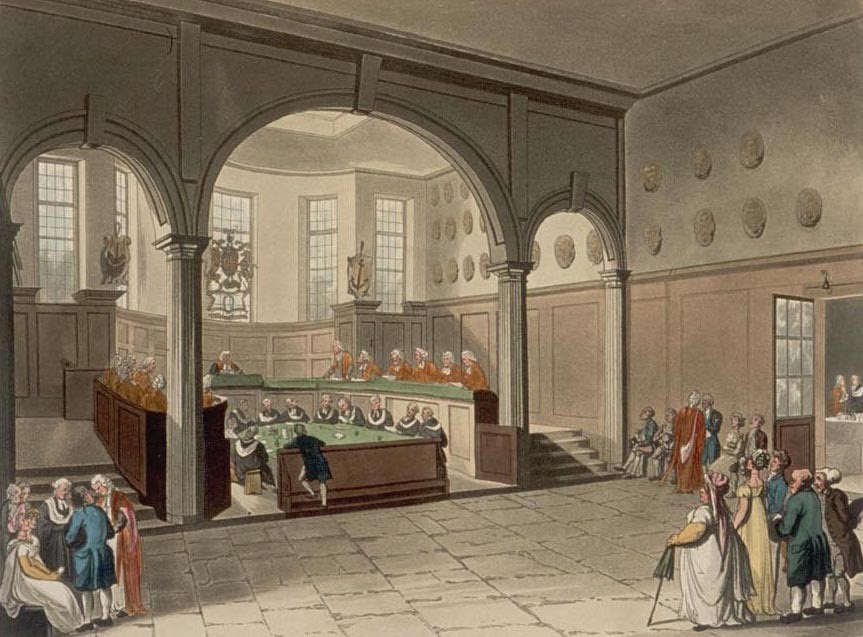
Figure 1: Doctors’s Commons, a society of lawyers ecclesiastical and admiralty law.
Source: Wikimedia Commons, https://en.wikipedia.org/wiki/Doctors%27_Commons
Could you expand more about the common-law courts’ “then-still-strictly-adversarial procedure” and what this meant for the plaintiff?
This one’s a bit easier to address.
An “inquisitorial” system refers to a system in which the judge or the Court gathers information, in order to decide whether to convene a civil trial or criminal tribunal. The most infamous examples are the Spanish or Roman Inquisitions, but importantly those inquisitions were led by ecclesiastical or canon-law courts. Nevertheless, in the civil-law tradition, civil governments’ courts operated according to at least structurally similar principles—often (though of course not always) leaving it to the judge to gather information as needed, in order to determine whether court trials were necessary. This invited a legal culture in which people (as “informants”) submitted public, confidential, or anonymous “information(s)” to the Court for its consideration, with the understanding that how the Court then used that information was a matter of its own discretion. Now, in an early-modern English context, we don’t see that in common-law courts, but we do see the same kind of “informations” relayed to the royal court and thence to various departments. But as Peter Pope explains in Fish Into Wine (2004), it was common practice for English merchants to deposit information or sworn, written depositions with local vice-admiralty courts or the High Court of Admiralty—in case there would be a commercial suit later in which whatever information they had relayed at the time might be used in their favour. Informing the Court of one’s business transactions, in other words, was a form of insurance against accusations from another party.
In an “adversarial” system, though, the Court—at least in its capacity as a court—does not gather information about plaintiff or defendant, or accused criminals, prior to a trial. The trial itself was where the truth was to be revealed (one might say, “discerned”) through the “adversarial” contestation of two opposing parties. During this process, “the facts of the case” were to be introduced to the Court, upon which the magistrate or judge would base his decision when applying the law to those facts.
One might argue that in a smaller, rural, seventeenth-century setting, the question of gathering information about parties prior to a trial was a moot point, since in practice the judge—usually a senior member of society, often a landed gentleman—already knew most of the people in a given parish. (Higher-level county courts being another matter.) But this began to change in London in particular during the mid-eighteenth century, when urbanization made bourgeois anxieties about “the crowd” (read: “the urban poor”) that much more pressing. The problem was, English adversarial procedure—particularly at a time when Justices of the Peace received no salary—gave magistrates no incentive to keep tabs on the urban poor. This began to change in Westminster with the influence of Henry Fielding and, following his death, his brother Sir John Fielding. The latter in particular began keeping the first “police files” on record—which led to accusations of his being or acting like an “inquisitor.” In fact, the Fieldings were forerunners and pioneers in the system of a professionalized magistracy and police constabulary, since they set many reforms in motion that culminated in the 1829 Metropolitan Police Act. This included a practice of common-law judges (“police magistrates”) using state surveillance to gather the kinds of information about ordinary citizens that their counterparts in, say, France, Spain, or Austria had been doing for over a century.
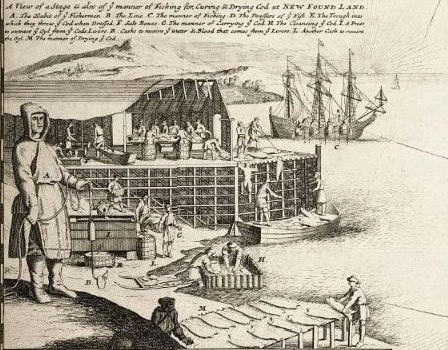
Figure 2: An Inset of Herman Moll’s Codfish Map
Source: Wikimedia Commons, https://commons.wikimedia.org/wiki/File:Moll_-_Inset_Codfish_Map.png

During this period, did Indigenous laws and customs influence civil law or common law developments in Newfoundland?
To be perfectly honest, I don’t have many particularly satisfying answers. No European legal system arrived in Newfoundland fully formed; those had to be imported piecemeal and by deliberate acts of the imperial governments. Plus, by the time either the French civil law system at Plaisance or the emerging common-law system of the English Shore were coming into their own, both English and French would have been fully convinced of their own cultural superiority over their Indigenous neighbours. I don’t know that there was really the same kind of sustained dialogue between, say, Mi’kmaw law and Plaisance that you’ll find between French Canada and local First Nations. (Never say never, though!) Certainly, most English legal, constitutional, or political developments at least appeared to take place in hermetic isolation from any direct Indigenous influence—though the extent to which this appearance is deceptive is in fact the focus of my dissertation.
That being said, I would suggest that, instead of starting with the more ambitious question of whether Indigenous practices influenced local common-law or civil-law systems, historians or other researchers might try exploring the more fundamental question of where local customs—here, customary practices—bear evidence of Indigenous influences, which might have been absorbed into either colonial system at a later date. One obvious place to start might be to ask: What did fishing admirals do in Newfoundland that local “admirals” did not do in Europe, or vice versa? Or, try asking something like: What customs did Basque, Portuguese, Breton, Norman, Dutch, or English crews practise across Newfoundland that they did not do either in Europe or elsewhere?
The problem is, anyone wishing to consult written evidence alone has their work cut out for them; and even those consulting other archives would do well to work out very specific research questions. Then again, we have yet to have an Indigenous jurist’s study of something like the fishing admiral system or its successors from a Mi’kmaw, Innu, or Inuit perspective. Barring that, one might simply ask Indigenous Elders and other knowledge-keepers what practices they recognize were shared in common with their non-Indigenous neighbours—and when. I think we might be surprised as to what an Innu-led history (to say nothing of a legal history) of the fur trade that took place in their own territory might look like. (What would an Indigenous-led anthropological study of English or French Newfoundlanders look like, I wonder? What might they recognize as “law” that university-trained academics might not? And so on.)
Others have noticed some broad similarities that have yet to be explored. For example, in their M.Phil. thesis, Jo Harris noted a similarity between Mi’kmaw seasonal land use patterns and Newfoundland “cabin culture.” And in Labrador—where, I should explain, I have not yet been—there is perhaps a greater acknowledgement that Indigenous ways of seeing the world and each other inform local attitudes in non-Indigenous communities as well. Even so, I’m only aware of one essay that examines the encounter between English and Inuit legal orders, with the assumed confrontation being between Inuit and English common law. I will add, though, that the fact that many of the Moravian missionaries were Germans should perhaps lead us to ask whether a German civil-law influence has also shaped the development of common-law tradition in Northern Labrador—both alongside Inuit law and as an alternate lens through which the question of “custom” could be seen.
From this distance, I think I can at least offer the caution that it would be important to look for not just one ahistorically homogeneous“pan-Indigenous” influence on colonial legal orders, but four—Beothuk, Mi’kmaw, Innu, and Inuit. (And readers looking for a sense of likely sites of interaction in a nineteenth-century “borderlands” context should check out Kurt Korneski’s 2016 book Conflicted Colony.)
So far as my own area of expertise is concerned, a useful challenge might be to ask to what extent Indigenous geographic and environmental knowledge—particularly Beothuk knowledge—informed the local customs that English, French, Basque, and Portuguese fishermen adopted. If anything, given the fact that there was easily over a century of interaction before the first colonial charters based on local knowledge were issued in 1610, it would be strange if there was not some influence—despite stereotypes of the Beothuk as temperamentally “reclusive,” based on their behaviour in later centuries. By the seventeenth century, though, consider the prohibitions on what one should or should not do each year during the fishing season, not just in one colonial charter but consistently with English and French fishery regulations. Why did both English in 1634 and French in 1642 recognize Cape Bonavista as the limit of northern settlement? Does this point to some sort of prior agreement with the Beothuk that went unrecorded in the written records, but which was absorbed into the transatlantic maritime traditions? Not to give away the game, but suffice it to say this is something I’m exploring in my dissertation.
In any event I would certainly recommend that readers interested in this kind of question keep an eye out for any future publications by Joe Borsato. He’s recently done some considerable work on early-modern expressions of Indigenous sovereignty, and from what I understand the Beothuk have not escaped his attention.
Have you read anything good recently?
I have a long list of books that I’m in the middle of reading, and that graduate work has unfortunately sidelined. (Augustine’s City of God, the rest of Dante’s Divine Comedy after the “Inferno,” and Cervantes’ Don Quixote, to say nothing of the stack of classic studies left over from my comps reading.) I’m immensely enjoying the Cambridge History of Ireland as well!